Alexis
The Reincarnated Demon King's Host Just Wants to Live in Peace, But the Hero Won't Leave Him AloneAlexis, also known as King Alexis and the King of Rizaah, is the human monarch whose authority links the royal court, the Hero’s party, and the wider wartime government of Algeya. His decisive appearance comes when he must determine what to do with Theo Bladefoot, a healer whose concealed identity as the host of the reincarnated Demon King makes him both a political danger and an invaluable resource. Alexis does not simply reduce Theo to either a criminal or a weapon: he recognizes the kingdom’s claim on Theo’s gifts while also acknowledging the village that depends on his healing.
Position in the Capital and Court
Alexis rules from the throne room at the center of the capital’s palace complex. The palace is divided between the royal residence and the institutional spaces where magic users and knights are trained, including those who may serve the royals or join the Hero’s party. The court’s authority is therefore both domestic and military. It governs a kingdom threatened by surviving Demon Lords, while relying on a unified political structure in which the mortal races cooperate against the common enemy.
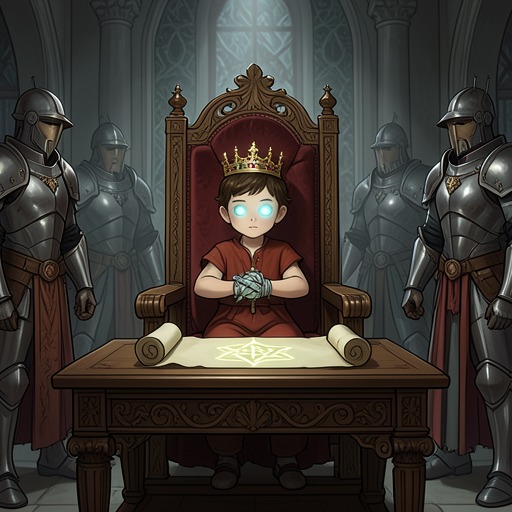
By the time Theo returns to the capital, Alexis’s health has visibly deteriorated. More than twenty summers after Theo last saw him, the King has deep lines around his eyes and hair that has turned mostly grey. He sits on the throne while the court mage presents Theo, surrounded by guards and watched through mirror magic by representatives of the other rulers of Algeya. The room’s magical mirrors allow distant councils to participate without the costly work of opening portals, turning the throne room into a space of public surveillance as well as government.
The Hearing of Theo Bladefoot
Alexis initially allows the court mage’s formal presentation of Theo as Healer Theo Seamsword, but he raises a hand when a murmur spreads after Theo corrects the name. Theo insists that he is Theo Bladefoot, Healer of Leafel, rejecting the name associated with the people who gave him away. Alexis’s response is restrained rather than punitive. He asks why Theo abandoned Priest Camden’s care, distinguishing fear from the deeper reason behind his flight.
The King then states the central conflict in institutional terms: Theo’s gifts are vital to Algeya’s war with the demons, and Alexis knows that Theo and Hero Luca have formed an attachment. If Theo will not serve the country, Alexis says, he should at least serve Luca. The formulation exposes the pressure placed on Theo, whose healing ability is treated as a public asset, but it also shows that Alexis understands the personal bond at stake rather than pretending that duty exists apart from it.
Alexis nevertheless asks whether removing Theo would deprive a small town of its healer. Theo explains that he has begun training Micah, who can manage potions and stores but has only a few weeks of experience using healing magic. That practical detail changes the court’s decision. Alexis acknowledges the weakness of Leafel’s replacement and decrees that Theo will serve in the Hero’s party for one year from that day, or until the party has dispatched the demons attempting to rally forces. Theo accepts the decree, surprised that it is less severe than expected, and Alexis permits him to return to Luca.
The decision is a compromise, but not an act of freedom. Theo has been brought back to the capital through a portal and understands that those in power now know who he is and where he lives. He fears that the court will force him into the Hero’s party and expose the truth about his possession by Malthios. Alexis’s decree limits the duration of that obligation, yet it still confirms the crown’s power to commandeer Theo’s body, magic, and future in the name of Algeya’s defense.
Authority, Bloodline, and the Heroic System
Alexis’s rule is set against a system that treats the Hero’s party as a continuing national instrument. The party protects ordinary people from remnants of the Demon King’s army, while magical training and royal service prepare selected individuals for that task. Theo’s healing is valuable because the state’s conflict with the demons has made extraordinary abilities politically necessary; the same necessity also supplies the justification for overriding personal choice.
The court’s pressure is intensified by the question of succession. Julius tells Theo that Eliza wanted Luca to continue the heroic bloodline and sire the next Hero, something that could not be achieved with either Julius or Luca’s other former male partner. Alexis does not personally deliver that threat in the available scene, but his court represents the same order in which Luca’s life can be measured by service, lineage, and usefulness. Theo’s attachment to Luca consequently challenges more than a private expectation: it contests the assumption that the Hero belongs first to the crown and to a reproductive future designed by the institution.
Alexis’s compromise reveals a monarch balancing competing obligations rather than abandoning the system that creates them. He cannot simply release Theo while the demons are rallying forces, but he also cannot ignore Leafel’s dependence on its healer. His decree makes the village’s welfare legible within royal policy, even though Theo must still surrender a year of autonomy.
The Trial and the Limits of His Protection
Alexis’s court later becomes the setting for the trial of the Demon King’s host. After Theo’s identity is confirmed, he is transported to the capital with magical restraints and taken to the dungeons before being brought into a crowded throne room. Alexis’s presence is part of a public spectacle: a mirror above the throne shows the proceedings to towns, villages, and cities throughout Algeya, while the court, distant rulers, and Hero’s party observe Theo kneeling before the throne.
The formal charge identifies Theo Bladefoot as the host of the reincarnated Demon King, Malthios. The court reaches agreement that Theo is guilty for protecting Malthios, demonstrating how quickly the political system converts concealed identity into collective condemnation. Alexis is not shown interrupting that judgment before the trial’s public confrontation. His earlier willingness to grant Theo a limited term does not prevent the court from placing Theo under a harsher jurisdiction once the host identity becomes undeniable.
The proceedings are disrupted when Micah opens a new mirror spell from Leafel. Behind him stand Imani, Dale, Dmitri and his parents, Nib, Amaya, and the people of the village, while Hayden demands Theo’s release from the King and council. Their intervention challenges the court’s claim that Theo can be defined solely by his connection to Malthios. Alexis’s political world is thus forced to witness a rival form of judgment: the community Theo served refuses to abandon him, even after learning what he carries.
Characterization and Narrative Significance
Alexis is characterized through decisions made under pressure rather than through private history. His ageing body, formal court, guarded throne room, and control over Theo’s service establish him as a representative of institutional continuity. Yet his treatment of Theo is more measured than the surrounding machinery of conscription and trial. He asks about Leafel, accepts the existence of Micah’s unfinished training, and sets a defined endpoint instead of demanding indefinite service.
That moderation is politically ambiguous. Alexis’s decree offers Theo a survivable compromise, but it does not erase the coercion that brought him to court or the danger created by a state that evaluates people according to magical usefulness. His authority can recognize local need only after Theo explains it, and it cannot guarantee protection once Theo is publicly identified as Malthios’s host. Alexis therefore embodies the tension between governance as stewardship and governance as possession: he can temper the system’s demands, but he remains one of the figures empowered to impose them.